Wednesday, July 7, 2021

Kent State and Comics, a look back. Part 3


Of all the political cartoons about the Kent State Massacre that I've found, this one (above) is head and shoulders above the rest. It's from National Lampoon, the great satire mag of the Seventies, October 1973. It appeared just three years after the events of May 4, 1970, and when the pitched political battles over the shootings were still being hotly contested. The indicted 25 students (and one faculty member) had their cases abandoned by state prosecutors in late 1971. The six Guardsmen who the FBI identified as shooting into the crowd of students would be indicted and put on trial in 1974, and were quickly exonerated when charges were thrown out of court. So this satire falls right in the middle of all this.

It's not terribly well drawn, but is brutally hilarious. It was conceived by writers Marc Rubin and Chris Miller (who later co-wrote Animal House) and drawn by Francis Hollidge, a pseudonym of veteran comics artist Frank Springer.  Frank took over for Jim Steranko on Marvel's Nick Fury, Agent of SHIELD. 
Guess Frank felt he needed to use a fake name, to avoid trouble.

The Kent State piece is a comic book ad that spoofs the cheap Army Playsets that were always advertised in comic books. There were sets for World War 2, the Revolutionary War, the Roman legion, etc. 


The Kent State ad ran on the inside cover of a larger spoof comic book, G. Gordon Liddy, Agent of CREEP, a highlight of this issue of NatLamp. CREEP was Nixon's infamous Committee to Re-elect the President... and creeps they were, being responsible for a long list of illegal "dirty tricks," as well as the bungled Watergate break-in, which was blowing up in 1973 and would bring down Nixon less than a year later. That operation was led by Liddy, who was uncooperative and unrepentant. He was sentenced to 20 years (commuted by Jimmy Carter, for some reason).  he was released after 4 1/2 years in the pen, the last of the seven convicted Watergate conspirators to be freed.
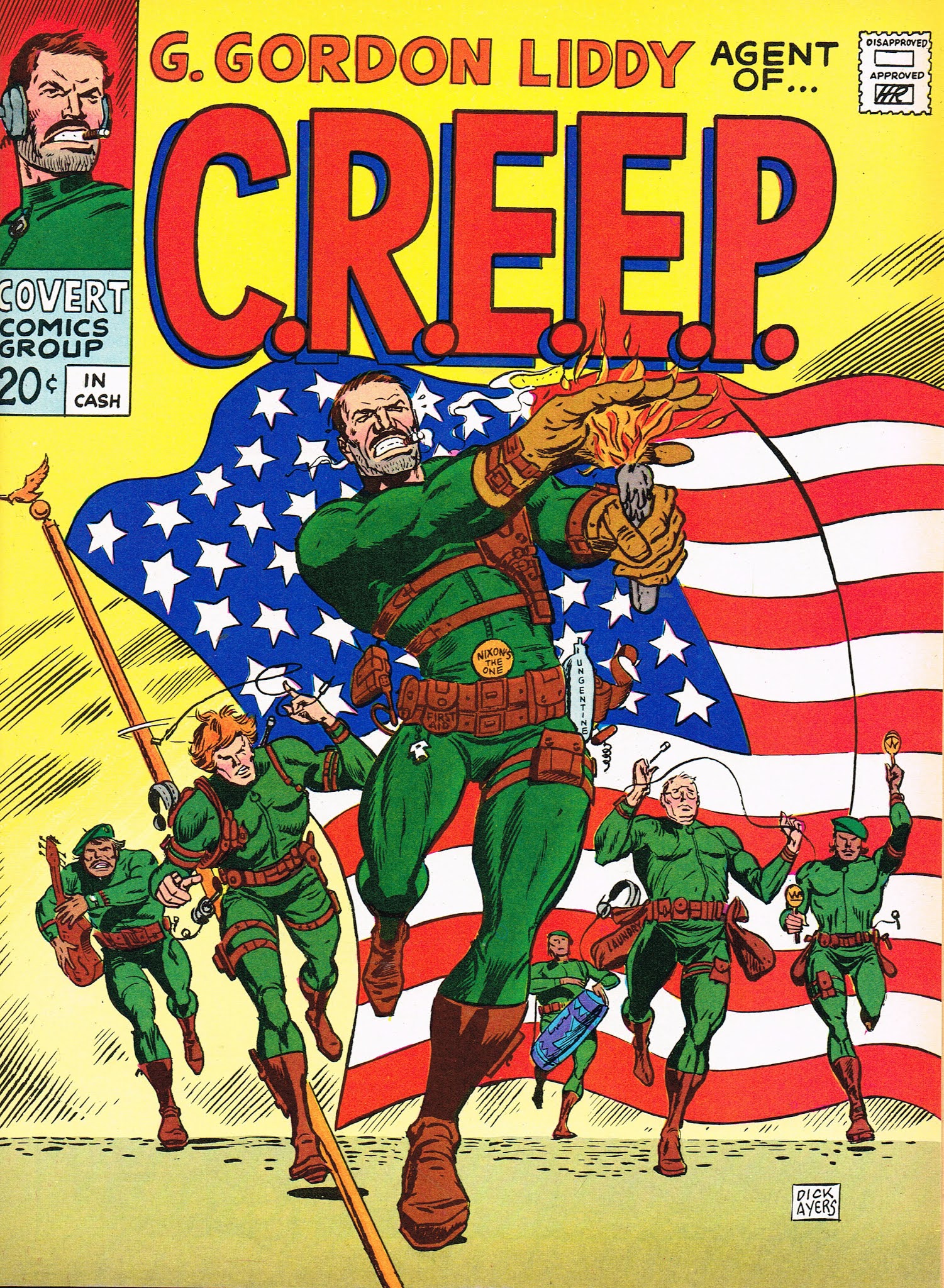


The best part of the satire is the Kent State ad. That one packs a wallop! So much so, I've never shared it on social media. Too many of the Students of 1970 follow me there. I think this piece would hit WAY to close to home for them, but... man!... as a political cartoon, it's absolutely great.


Tuesday, July 6, 2021

A Kent State artifact, a yearbook like no other

This is a copy of the 1971 Kent State yearbook, The Chestnut Burr. It's the edition that documents the events of May 4, 1970. A crucial piece of source material for me.

It's a remarkable book, and the only university publication that documented the tragedy. Immediately after the massacre, the university was closed, and all students were ordered to be off campus (and, in fact, across the city limits!) by 5 pm or face arrest. This order also closed the Daily Kent Stater, the school newspaper, which had been been closely following the escalating protests at Kent. Since the Stater only published Tuesday through Friday, it didn't publish a word of its reporting on the unrest, which began Friday afternoon. 

As a result, all the on-the-ground reporting, all the incredible photos, had no place to be published! The Ohio governor effectively muzzled The Kent Stater. Some of the photos found their way to mainstream publications, be it the wire services or magazines like Life and Time, but much of it would have never seen the light of day, if not for the yearbook.


Above: the Guard moves on students, driving them up Blanket Hill, even though most weren't protestors at all, merely kids on their way to and from class who stopped to watch. This contingent of soldiers are the ones who inexplicably opened fire. Note the man in the bottom right, following the Guard as they move up Blanket Hill and taking photos. That is the student FBI informer, Terry Norman, whose full role on that day is still unknown.


Above: included in the yearbook is a flexidisc, with "The Sounds of May 4." On it are various news reports from that tragic day and the events that preceded it.


Above: the events of Friday, May 1, that kicked off the conflict on campus. Students burying a copy of the Constitution (left page) is the opening scene in my book. On the right is one of the few photos from the riot on Water Street that night. There just weren't many photogs present, and, of course, no cellphone images or video as we have today. The photo technology of the day made shooting at night, with harsh lighting conditions, and from a distance, damn near impossible. It's hard to understand, for those who didn't shoot photos in the film era, how challenging (and expensive!) that technology was, compared to the super-computer cellphone cameras we all have now.


Above: the tense events of May 3, when Ohio Gov. Jim Rhodes arrives on campus and grandstands for his base. His fiery, table-pounding press conference ratcheted paranoia up to a fever pitch.


Above: the Guardsman with flowers in his gun barrel, which Allison Krause immortalized, a few minutes after this photo was taken, with "Flowers are better than bullets!"


Above: The grim carnage. Has any other yearbook in American history included such images? I doubt it. Student photog John Filo's iconic photo of Mary Ann Vecchio wailing over Jeff Miller's body (top center) won him the Pulitzer Prize. It's curiously downplayed in this layout.


Above: the understated cover of the yearbook.


Above: the rest of the yearbook offers a positively bizarre contrast of typical college events. Here's a spread on Kent State's rotten 3-7 football team, as if anyone cares.


Above: even more bizarre are the requisite photos of Greek life. Here the ladies of Delta Zeta beam for the camera, as if the massacre documented a few dozen pages previous hadn't happened at all.


Above: the men of Phi Gamma Delta, posing proudly in their frathouse rec room, with their bar glasses neatly displayed, is a real eye-roller, too. At least they had the sense to not pose hoisting full beer mugs!


Above: the yearbook ends with a reprint of the complete investigative report that ran in the Akron Beacon Journal three weeks after the massacre. The ABJ won a Pulitzer prize for its breaking news coverage of May 4. 

This special report was produced by a Knight-Ridder Newspapers team working out of the Beacon newsroom. Knight-Ridder was the parent company of the ABJ, Akron press baron John Knight being the owner of both the ABJ and of Knight-Ridder.  The team was  mostly reporters and editors from the Detroit Free Press, another Knight-Ridder paper, although they relied heavily on the Beacon reporting. They were not exactly welcomed with open arms in the Akron newsroom, where staff felt they were elbowing in on the Beacon's story, but it's an excellent report. It ran in all Knight-Ridder papers, a dozen or so, on May 23, 1970. It was a Pulitzer finalist. 

The special report was met with fury by Akron readers, because it blows holes in most of the National Guard's excuses for opening fire on a parking lot full of students, most of whom were not protestors. Jack Knight later joked that this report cost him $1 million in lost subscriptions and advertising. 


Sunday, July 4, 2021

Kent State and Comics, a look back. Part 2


Continuing my examination of how student protests were depicted in mainstream comics during the Kent State Era, here’s two examples from DC Comics, Flash #185 and Teen Titans #31.

The Flash has a pub date of February 1969, just before the mass campus unrest in the Spring of that year, including the events at Kent State that led directly to the Guard moving in to crush dissent a year later. The Titans has a pub date of February 1971, so it was on the stands in Fall 1970, just six months after the Kent State Massacre. So what we have here is an interesting before/after Kent State comparison.

On both covers, student protestors are depicted as a violent mob, using a predictable image of the hero getting whacked with a “Make Peace, Not War” sign. How many times did rightwing political cartoonists use THAT tired gag? The editorial leadership at DC Comics in 1969 was pretty reactionary. Some, like the infamous Mort Weisinger, loathed 1960s youth and submarined any attempt to portray them sympathetically!

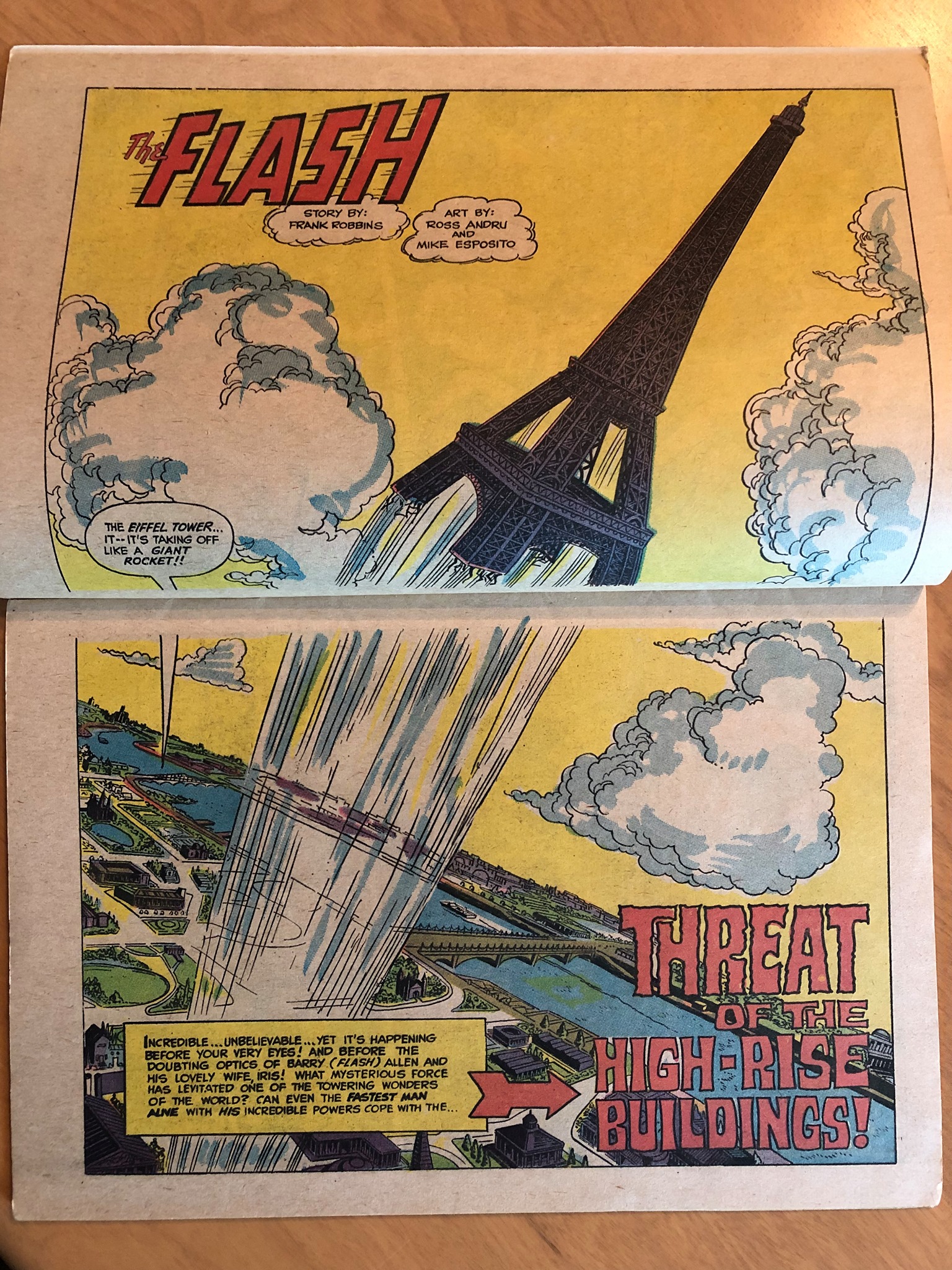
DC was also notorious for dreaming up provocative covers FIRST, then writing a story to play off the cover. Usually this resulted in a pretty shitty book, and Flash #185 is certainly an example of that. The story? It has nothing to do with student antiwar protests at all!  Instead, it’s a goofball tale of aliens stealing the Earth’s tallest buildings, including the Eiffel Tower! It’s total nonsense. Written by comics veteran Frank Robbins, too, who penned many classic Batman stories in this era. This one is a real turd. Oh well.


Since antiwar protestors are present only on the cover, so let’s file this one under WTF.

Teen Titans #31 is also a crazy book, but at least the cover is related to the story. The Titans visit a college, where an evil university president is forcing students to undergo brain operations to make them compliant and thus control campus unrest.


No. really.

This story, however, portrays students as innocent victims, and the authorities as the bad guys! This is the first time THAT happened in a mainstream comic book. Over at Marvel, Stan Lee always made his stories about student protests politically ambivalent. Students were well-intentioned, the authorities were reasonable, why can’t we all get along blah blah.


There was no way in hell DC would have allowed this book to see print a year earlier, but a lot had changed in the space of 12 months at DC. Old conservatives like Weisinger retired (or were shoved out the door). Publisher Carmine Infantino cleaned house. A big influx of young creators was brought in, with a desire to tell stories that mattered to them. Is Titans #31 a reaction to Kent State and the mass campus unrest of Spring 1970? Sure seems that way.

The author of Titans #31 is Steve Skeates, one of youngest DC writers, only 28 here. The Titans were one of DC’s “relevant” titles, tailored to appeal to progressive youth. Skeates also wrote Aquaman at this time, who became an environmental crusader, and Hawk & Dove, a wacky concept about the country’s political divide. He wrote a lot for DC’s wonderful gothic horror line and then became one of Warren’s busiest writers in the 1970s, penning dozens of stories in Eerie, Creepy and Vampirella, before burning out and leaving the biz.

In any case, this is a pretty daring story to put on the spinner rack at the height of Nixonian paranoia about the student left.


"Just what parents would want us to do"... lobotmizing their children! Honestly, that sentiment probably wasn't that outlandish in 1970!


This dialogue is chilling, because "outside agitators" were cited by Ohio Gov. Rhodes as one of the reasons for sending in the Guard to crush protests at Kent State. It was a common theme by reactionaries. A large secret cabal of "professional radicals" was going from campus to campus, stirring up the otherwise docile local youth, and creating chaos. It's spooky seeing this stuff filter down into pop culture, knowing how deadly serious it was in real life.


This (above) is very much still a question. After Trump and the past several years, I fear a large segment of the population IS that easily subverted. Prescient stuff from 50 years ago.

Note, however, that the plot in all these comics stories I’ve been examining is always the same, no matter the publisher, Marvel or DC. It’s never a portrayal of legitimate protest over the Vietnam War. It’s always misguided students being manipulated, or mind controlled, by insidious villains. Over and over comic book writers use that cheap plot device, because God knows no student in 1970 could have a REAL beef with the government, right?
 

Friday, July 2, 2021

Kent State and Comics, a look back. Part 1

I'm fascinated by how the Kent State Massacre, and student antiwar protests in general, were dealt with in comics back in 1969 and 70. 

Today I'll look at the political cartoonists. The Kent State Massacre happened on Monday, May 4, giving cartoonists ample time to weigh in that week. I was surprised by what I found. Very few did! I scoured newspaper archives online looking for examples and found very little. I guess this event was too hot a topic. The first reaction, after all, from mainstream, middle-aged America is that "we should have shot MORE." In a Gallup Poll a week after the Massacre, almost 70% blamed the students for being shot, and not the soldiers who shot them. I suspect newspaper editors were keenly aware of this sentiment, and a majority probably shared that view, and warned their cartoonists to back off.

But I did find a few examples. Let's start with one that appeared in The Cleveland Press the day after the Massacre. Cleveland is a mere 38 miles from Kent and the student body was full of Cleveland kids. This cartoon is by longtime cartoonist Bill Roberts, age 56 in 1970. He was right-of-center on most issues,  in keeping with the politics of the big afternoon daily. The Press, like most afternoon papers, was a "working man's paper." It certainly wasn't psycho rightwing, like media is today. Perhaps "traditional" would be a more apt description. Certainly, the paper was no fan of student radicals, or of the Woodstock Generation in general. If 20somethings were written about at all in 1970, it was dismissively, or with outright mockery. 

This cartoon, well, doesn't really say anything at all. Yes, students are dead and, yes, that's a tragedy. The problem with the Kent State story, of course, is that it unfolded piecemeal over those first few weeks, and a lot of the official statements and assertions were either wrong or outright lies. The first 20 statements by Guard leadership, for example, were all lies, as they desperately tried to cover up their crime. Pretty tough to draw a cartoon about something when you have no clue what actually happened.


Here's one from Pat Oliphant, one of the "new breed" of political cartoonists who transformed the genre, and moved it away from the dry, humorless cartoons of old pros like Roberts. Having said that, this is not one of Oliphant's better efforts. What exactly is happening here? The SDS Radical is pulling on the Cheese of Anarchy. What exactly IS the Cheese of Anarchy and why would SDS want such a foodstuff? They're about to get clobbered, but wouldn't the mousetrap be enough? Why is there a spiked iron ball attached to it? I suspect just so Oliphant had a place to write "reaction." 


Ray Osrin of the Cleveland Plain Dealer penned this one (below). Again, it says nothing, but even the most reactionary subscriber has little to object to here. Kent State was the most divisive event of the 1970, a year that was abysmal all around, one of the worst years we've ever had. In Ohio, that divisiveness over Kent State was amplified many fold. This, after all, happened in our back yard. For example, the Akron Beacon Journal (which didn't have a political cartoonist in 1970) won a Pulitzer Prize for its coverage of the Massacre. But readers were so incensed that the Beacon refuted many of the Guard's lies, that subscribers cancelled in droves!

The point being, cartoonists in these parts had to tread very softly.


Below is a cartoon by Cy Hungerford of The Pittsburgh Post-Gazette. Hungerford was 82 years old in 1970!  Dude was born in the 19th century! As you can tell, he was no fan of the whippersnappers on campuses. This one is a total piece of shit. We've got Death, dressed from the waist down as a Guardsmen, and from the waist up as a student protestor, running onto the Kent State campus.

Huh? 

This one reads, and looks, like ol' Cy scrawled it out in 5 minutes, which is probably exactly what happened.


Wish I had a clearer copy of this one, by the great Bill Mauldin. This is from a few months after the Massacre, when a state grand jury issued indictments. It was convened as a kangaroo court by Ohio Gov. Rhodes, the Nixonian strongman who was most to blame for what happened at Kent State. The judge was a Rhodes ally, the prosecutors were, too. In the end, the grand jury cleared all the soldiers who fired, and their officers, and completely exonerated Rhodes, and instead indicted the students who were shot! It was a travesty. All of the indictments were eventually abandoned by prosecutors. 

Mauldin cuts right to the heart of it. Heavily-armed soldiers shot and killed students who were armed only with words.


Below is a cartoon by Mike Peters, the renowned cartoonist of the Dayton Daily News. Peters was never one of the more savage political cartoonists and this one is fairly typical of his work. UN Observers sent in to keep the parties separated, just as they were in Northern Ireland in 1970, at the peak of The Troubles there. Peters isn't far off equating what was happening in 1970 America to civil war. We were on the knife's edge of that.  


Another Ohio cartoonist, and another old-timer, L.D. Warren, penned this one for the Cincinnati Enquirer.

Well, he's certainly making a statement here, placing the blame squarely on "violent" student protestors. The problem was, of course, that the protestors on May 4 were peaceful. It was the Guard that was violent. The 400 protestors on the Commons that day were merely chanting, as was their right of free assembly in a public space on a public university that was open. The Guard gassed them, and marched on them with bayonets and batons, beat anyone who didn't move fast enough, and then shot them.

Details, details, right L.D.?

Cincy was a pretty conservative place in 1970. I'm sure the readers nodded their approval at this one.


And finally, here's one from Don Wright, the great multi-Pulitzer-winning cartoonist for The Miami News. He's working from the relative safety of sleepy South Florida, true, but at last here's a powerful cartoon. This appeared on Wednesday, May 6, two days after the Massacre. As I wrote, much was still unknown, but Wright astutely zeroes in on what WAS known: the students were unarmed and the Guard killed them without justification.


Thursday, July 1, 2021

A rare Kent State artifact


Here’s an original art score I just acquired.

This is a political cartoon about the Kent State Massacre, from 1970!

It’s by Newton Pratt, the longtime cartoonist for the Sacramento Bee. Pratt was 69 and just one year from retirement when he penned this one. Pratt was a well-regarded cartoonist of the Herblock School, as you can see. Vertical format, lots of crayon, lots of labels.

This cartoon is blasting the Ohio State Grand Jury verdict of October 16, 1970, just five months after the massacre. Gov. James Rhodes, the man most responsible for the tragic debacle, convened a kangaroo court to “investigate” the shootings, and bury it. Rhodes installed a staunch ally as judge, and allies as prosecutors. The grand jury was convened in the rural county where Kent State is located, thus ensuring a jury pool of conservative locals with strong animosity against students in general, and student protestors in particular. Attempts to move the jury to a neutral county were quashed. Rhodes’ judge and prosecutors also made sure that the governor was not brought to the stand.

After several months of secret testimony (all reportedly destroyed by order of the judge after the rulings) the grand jury exonerated all the Guard officers and the Guardsmen who shot at students. Instead, the jury indicted 25 protestors who were shot AT, including most of the wounded students! It was an utter travesty.

This was Rhodes rebuttal to the Scranton Report that was issued in September, which placed blame for the massacre squarely on Rhodes’ decisions and on Guard leadership. The Scranton Commission was convened by Nixon to investigate the campus unrest of Spring 1970, specifically the slaughter at Kent State and Jackson State. Rhodes was furious at this political betrayal by Nixon and the FBI. Rhodes had been one of Nixon’s earliest supporters, and was a big reason Tricky Dick won Ohio in the 1968 election. But Rhodes was to be term-limited out of power at the end of 1970, so he was of no further value to Nixon, and Tricky threw him under the bus to distract from his own machinations against the Antiwar Movement. Classic Nixon! Rhodes officially rejected the Scranton Report, and his Grand Jury provided him cover to slink out of office… and to be reelected four years later!

The Kent 25, as they became known, faced decades in prison on a plethora of state felonies. This scathing cartoon asks the question, why didn’t Ohio indict the murdered students, too?

By Fall 1971, the state’s cases fell apart. A couple students plea-bargained their felony charges down to simple misdemeanors, a small fine and no jail time. A student who took his case to trial was exonerated. At that point, prosecutors DROPPED all felony charges against the remaining protestors and abandoned the indictments! Clearly, they didn’t want witnesses called to testify under oath, especially Rhodes and Guard brass, because THIS testimony would be public record, not sealed and destroyed like the grand jury testimony. Rhodes was also out of power by Fall 1971, and his Democrat successor had no interest in Jimbo’s vendettas or ass-covering.

A lot of political cartoonists are lost to time, theirs being the comics genre with the shortest shelf life. Here’s the only bio info I could find on Pratt. He was a native of Sacramento, born to Irish immigrant parents. He dropped out of school at age 10 and began working, eventually becoming a draftsman for the state Division of Highways. At the Sacramento Bee, Pratt worked at a variety of jobs including messenger, office boy, and copy boy. Walter Jones, the head editor for the newspaper, eventually hired Pratt as the main editorial cartoonist in 1938. His work was reprinted by the New York Times and Washington Post, which brought Pratt national acclaim. In the 1950s, Pratt was one of the first editorial cartoonists to take on Senator Joe McCarthy’s anti-Communist hysteria. By the time Pratt retired in 1971, he had produced roughly 7500 cartoons. He was a 3-time Pulitzer finalist.

This cartoon was made with pen & ink and black crayon. It’s drawn on coquille board, aka stipple board. The paper has tiny bumps, so when you drag a crayon across it creates that dotted shading. The whole thing can then be sized and shot as straight line art, but it has the effect of a halftone, without losing the strong, deep blacks. It was perfect for the ghastly reproduction of newspapers in the 1930s and 1940s. A guy who mastered this stuff could work fast, another benefit. It was definitely a dated look by 1970. The new generation of political cartoonists embraced then-modern art techniques, especially Zipatone dot screens and Craftint paper. Old-timers like Pratt were called “grease pencillers,” because of the stipple board technique.

I tried it a couple times when I joined the Plain Dealer in 1986. That was such a retro paper, 25 years behind the technological curve, and the supply storeroom in the art dept. was packed with vintage art supplies. My attempts failed miserably! There was a definite learning curve, and it wasn’t worth the effort.

Craftint here in Cleveland, who specialized in cartoon and comics art supplies, manufactured this stuff until the 1970s, then sold it to another outfit who produced it as Duoshade paper. There’s no stamp on the back to indicate it's Craftint, unfortunately.

This was a real find, being the author of KENT STATE. Believe it or not, there were not a lot of political cartoons, that I could find, about the Kent State Massacre in 1970. It was just TOO hot a topic. Cartoonists shied away for it, or, more likely, were ordered by their editors to do so. I was thrilled to stumble across this original. 


Wednesday, June 30, 2021


I just stumbled across this. This is the last cover I did for a Cleveland weekly paper, from 2010.

End of an era.

It’s not the cover that ran, because the management at the Cleveland rag at the time, Cleveland Scene,  rejected it. Too cranky, not positive enough. Obviously, I was NOT the man for THIS job.

15 years earlier, the editors would have LOVED this cover. I was at the Cleveland Free Times then and filled that paper with snarky cartoons. It was a lot of fun. I drew probably 50 covers in the Nineties for the Free Times, and for The Cleveland Edition before that. The business folks at those papers always told me that “Derf covers” had a higher pick-up rate. That’s because readers love comics! Something weekly papers had forgotten by 2010. And into the tar pit they sank.

Six months after this rejected cover, I had a messy break up with Scene and that was the end of my 20-year career in Cleveland weeklies. Happily, I got my book deal for MY FRIEND DAHMER at the same time and was on my way to much better things.

Y’know, looking back on it now, my demise in weekly papers is all a bit of a meh. It was horrible at the time, and I watched it all with despair. But now, in hindsight? Things change. Everything has its time. The savage snark of my newspaper strip was a Nineties thing. It fit beautifully with the era, and, not surprisingly, that’s when it was most successful, and the most gratifying to produce. In the 2000s, progressively less so. Humor changed. Maybe it was existential shock of 9/11… or the endless dreariness of the Dubya Years… or just the personality of that miserable decade. I didn’t see that clearly then. I do now. My biggest regret is not retiring the strip at the end of the Nineties and moving on full time to books. I did the strip WAY too long.

Still think this is a funny cover, though. Imagine it in color. The woman covered in cheesy tattoos, the Lake a nice algae green.

Crazy year


Right? And with all that's happened, the plague, the failed coup, the near collapse of democracy, etc etc, try releasing a book during such a year!

I know, I know, it's a petty concern, but hey, I'm an author. I'm allowed to be petty.  Besides, it's not like I came through this unscathed. I've taken some pretty hard hits.

KENT STATE? Here's the report, nine months after its release in September 2020. It's done well. It was nominated for two Angoulême Prizes (lost 'em both), won a French Critics Prize, and a big YA award from the American Library Association. It sold well during its initial release, all things considering. Remember, the release was delayed 6 months because of the lockdown, and Americans didn't care about anything but Orange Hitler, the election and COVID. So taking all that into account, I can't complain. In a "normal" year, yeah, it probably would have sold more. Wonder if we'll ever have a normal year again?

KENT STATE is currently in its 3rd printing. There are already translations in French, Swedish, Dutch, Spanish, Portuguese and Finnish. It sold like crazy in France. 

Above is the cover of FOCUSvif magazine in Belgium. There's also been a traveling exhibit about the book at train stations in France (You're reading that correctly. It truly is comics heaven over there). Here's some cool pics. These were taken in le Gare in Rouen, one of my favorite towns, with one of my favorite comics shops, Au Grand Nulle Part :


What got completely torched, of course, was all the appearances, fests and cons that usually come with a book release. Yeah, that all went up in a poof of COVID in Spring 2020. I'm feeling a bit sorry for myself because that would have been an EPIC tour. I only have so many book releases left, y'know? 

The good news is I'm tentatively scheduled to return to France in October for the fabulous Fall comics fests there. Fingers crossed.